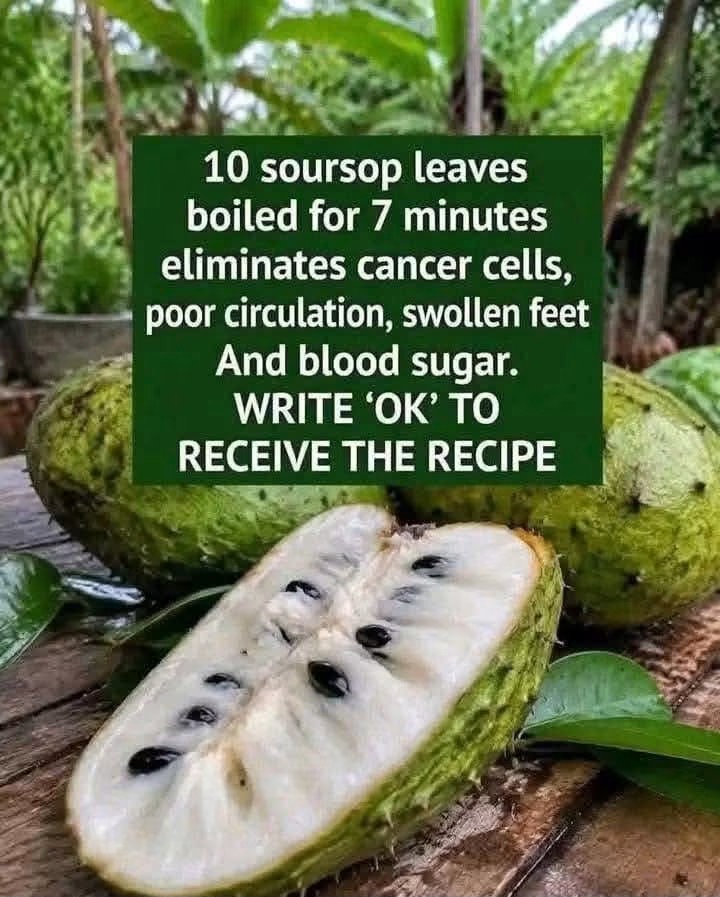
Soursop, also known as graviola or Annona muricata, is a tropical fruit that has been used as food and in traditional herbal practices for generations. The fruit has a distinctive green skin, soft white flesh, and dark seeds, while the leaves are sometimes prepared as herbal teas.
The image accompanying this article claims that boiling 10 soursop leaves for seven minutes can eliminate cancer cells, improve poor circulation, reduce swollen feet, and lower blood sugar. These claims are widely shared online, but they should not be treated as established medical facts.
Soursop has attracted scientific interest because laboratory and animal studies have identified potentially active compounds in the plant. However, evidence from laboratory experiments is very different from evidence showing that a treatment works safely in people. Memorial Sloan Kettering Cancer Center notes that although laboratory research has investigated graviola extracts for possible anticancer activity, human clinical evidence is lacking. (Memorial Sloan Kettering Cancer Center)
Understanding the difference between traditional use, laboratory research, and proven medical treatment is important before preparing or consuming concentrated herbal remedies.
What Is Soursop
Soursop is a tropical fruit that grows on the Annona muricata tree. It is also known by names such as graviola and guanabana.
The fruit is commonly eaten fresh or used in drinks, smoothies, desserts, and other recipes. Its leaves and other parts of the plant have also been used traditionally in various cultures.
Soursop contains a variety of naturally occurring plant compounds. Some of these compounds have been studied in laboratory settings because of their biological activity.
That scientific interest, however, does not automatically mean that drinking soursop leaf tea can treat a disease.
Can Soursop Leaves Eliminate Cancer Cells
This is the most important claim in the image to address carefully.
Some laboratory studies have found that extracts from soursop leaves, fruit, or other parts of the plant can affect cancer cell lines under experimental conditions. These findings can be useful for researchers because they may help identify compounds worthy of further investigation.
However, killing or slowing cancer cells in a laboratory dish does not demonstrate that a homemade tea will eliminate cancer in a person.
According to Memorial Sloan Kettering Cancer Center, clinical evidence supporting graviola as a cancer treatment is lacking. The organization specifically notes that there is no proof that graviola provides benefits for cancer patients as an alternative cancer therapy. (Memorial Sloan Kettering Cancer Center)
The National Center for Complementary and Integrative Health also advises people not to use unproven products or practices as a replacement for conventional cancer treatment. No complementary health approach has been shown to prevent or cure cancer. (NCCIH)
For that reason, soursop leaf tea should never be presented as a cure for cancer or as a substitute for surgery, chemotherapy, radiation, immunotherapy, targeted therapy, or other treatments recommended by qualified medical professionals.
What About Blood Sugar
Another claim in the image suggests that soursop leaves can help with blood sugar.
There is some scientific interest in this area. Experimental studies have investigated extracts of Annona muricata and reported possible blood-glucose-lowering effects in animal models.
However, results from animal studies cannot establish that a particular homemade tea will safely control blood sugar in people.
This distinction is especially important for anyone who takes medication for diabetes. Memorial Sloan Kettering notes that graviola may lower blood sugar and could potentially have an additive effect with blood-sugar-lowering medicines. (Memorial Sloan Kettering Cancer Center)
People taking diabetes medication should therefore speak with a healthcare professional before using concentrated soursop leaf preparations.
Does It Improve Circulation
The claim about poor circulation is also not established by good clinical evidence.
Circulation problems can have many different causes, including vascular disease, heart conditions, diabetes, blood clots, medication effects, or prolonged inactivity. Simply drinking an herbal tea should not be assumed to correct the underlying cause.
If someone has persistent coldness, pain, numbness, skin color changes, or other symptoms affecting the arms or legs, it is more appropriate to have the cause evaluated by a healthcare professional.
Treating an underlying medical problem is much more important than relying on an unproven herbal remedy.
What About Swollen Feet
Swollen feet or ankles can also have many possible causes. Sometimes swelling occurs after standing or sitting for a long period, but persistent or unexplained swelling can be associated with conditions affecting the heart, kidneys, liver, veins, or other parts of the body.
For this reason, there is no good basis for assuming that soursop leaf tea will resolve swollen feet.
Sudden swelling, particularly when it occurs on one side or is accompanied by pain, redness, warmth, chest discomfort, or difficulty breathing, should receive prompt medical attention.
Is Soursop Fruit the Same as Soursop Leaves
It is useful to distinguish between eating soursop fruit and consuming preparations made from its leaves.
The fruit is commonly consumed as a food, while leaf preparations may contain different concentrations of plant compounds. Memorial Sloan Kettering states that soursop fruit is generally safe to eat, while advising people to discuss graviola supplements with a healthcare professional. (Memorial Sloan Kettering Cancer Center)
A homemade leaf tea should therefore not automatically be considered equivalent to eating the fruit.
The concentration can also vary depending on the number of leaves, their age, preparation method, steeping or boiling time, and the amount of water used.
Safety Matters With Herbal Preparations
Natural does not always mean risk-free.
Soursop contains compounds that researchers continue to investigate, and there are concerns about possible neurological effects associated with some Annonaceae plant compounds. Memorial Sloan Kettering notes that preclinical research has raised questions about potential neurotoxicity and that more research is needed to determine safety and effectiveness. (Memorial Sloan Kettering Cancer Center)
There may also be interactions with medications. In particular, people taking medicines for blood sugar or blood pressure should be cautious because graviola may potentially lower both. (Memorial Sloan Kettering Cancer Center)
Anyone who takes prescription medication, is pregnant or breastfeeding, has a chronic medical condition, or is considering concentrated herbal preparations should discuss their plans with a qualified healthcare professional.
Why Seven Minutes and Ten Leaves Are Not Proven Dosages
The image gives a very specific instruction: boil 10 soursop leaves for seven minutes.
A precise number can make a recipe appear scientifically established, but there is no reason to assume that these exact measurements constitute a medically proven dose.
Herbal preparations are affected by many variables, including the size and maturity of the leaves, the concentration of the preparation, the amount of water, and the person’s individual health and medications.
Without appropriate clinical research, it would be misleading to claim that seven minutes of boiling produces a specific therapeutic effect.
How to Think About Soursop Tea
Soursop leaf tea can be discussed as a traditional herbal preparation, but it should not be promoted as a proven treatment for serious diseases.
There is a meaningful difference between saying that researchers are studying a plant and saying that the plant has been proven to treat a disease.
Laboratory findings can provide clues for future research. They do not establish effectiveness in humans, the correct dosage, long-term safety, or whether a homemade preparation contains enough of a particular compound to produce the laboratory effect.
That is why responsible health information should avoid promises such as “eliminates cancer cells,” “cures diabetes,” or “cleans the circulation.”
Final Thoughts
The soursop plant is an interesting subject of scientific and traditional research, and its fruit is enjoyed as a tropical food in many parts of the world. Researchers have investigated compounds from the plant for possible biological effects, including activity observed in laboratory and animal studies.
However, the claims shown in the image go much further than the available evidence supports. There is currently no reliable clinical evidence that boiling 10 soursop leaves for seven minutes can eliminate cancer, cure poor circulation, remove swollen feet, or safely control blood sugar.
Soursop leaf preparations should therefore be approached with caution, especially by people taking medication or managing an existing medical condition. Most importantly, herbal tea should never replace appropriate medical evaluation or proven treatment for cancer, diabetes, circulation problems, or unexplained swelling.
For anyone interested in traditional herbal drinks, the safest approach is to treat them as complementary foods or beverages rather than guaranteed cures, and to discuss concentrated herbal preparations with a healthcare professional when medications or medical conditions are involved.